Remote work gives people what they asked for: no commute, more control over the day and fewer interruptions. But the same freedom makes it easy to never really stop working. Burnout in remote teams rarely arrives with a crash. It builds up quietly, one late message and one skipped break at a time.
This guide turns a practical training framework, refined through external feedback, into four steps any small team can start this month. It is based on the Healthy Remote Work Training Framework developed in the EU-funded RemWork4SMEs project, which metalaxis co-developed with European partners.
Why remote burnout creeps up on small teams
During the project, 41 remote workers and managers, mostly from Czechia, Poland and Cyprus, answered a survey about how remote work really feels. The picture is mostly positive, which is exactly why the risks are easy to miss:
- 39 of 41 said remote work gives them more flexibility, fully or somewhat.
- 11 of 41 typically work more than 8 hours a day when remote.
- 23 of 41 named lack of face-to-face contact with colleagues as something that hurts their productivity, and 17 named procrastination or low motivation.
- 8 of 41 said remote work had a negative effect on their mental health, and 8 said the same about their physical health.
Small companies feel this most. There is usually no wellbeing team, no ergonomics budget and no written rules for hybrid work. The good news: the fixes are small, cheap and teachable.
Step 1: Protect mental and physical well-being every day
Stress you don’t notice is stress you can’t manage. The first part of the framework focuses on understanding what causes stress in remote settings and building simple daily habits against it.
- Run a 10-minute mindfulness session (breathing, short meditation or grounding), led by a colleague or an app such as Headspace or Calm.
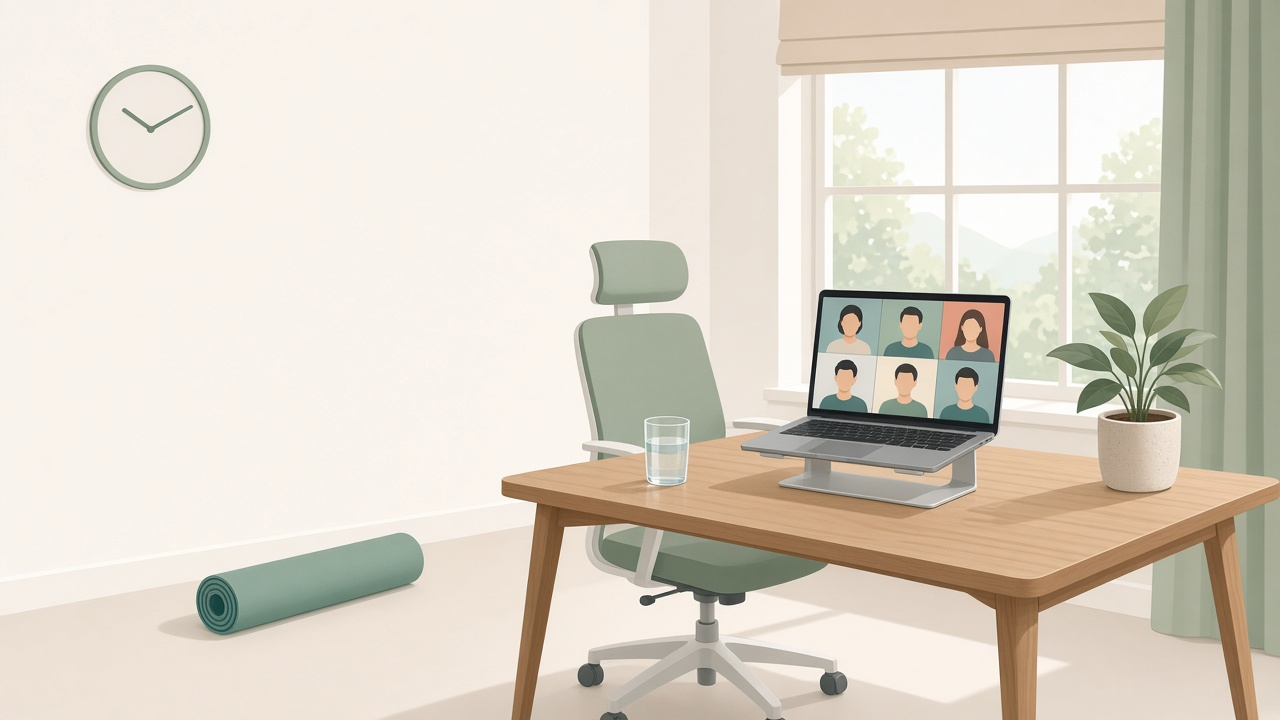
- Build desk stretches, posture checks and movement breaks into the day, plus regular hydration.
- Ask each person to create a personal “wellness calendar” with mindfulness, physical activity and scheduled breaks.
One Czech SME in the framework’s case studies introduced “Stretch-and-Chat” sessions: short virtual stretching breaks designed to reduce stress and give remote colleagues a reason to connect beyond tasks.
Takeaway: Put breaks in the calendar. If they are not scheduled, they will not happen.
Step 2: Draw clear lines between work and life
Flexibility without boundaries turns into “always on”. The second part of the framework helps people manage their time and say no to work that spills into the evening.
- Try the Pomodoro Technique: 25 minutes of focused work, then a 5-minute rest.
- Use time blocking to reserve hours for work, breaks and personal life, and switch off work notifications outside them.
- Do a one-day “time audit” to see where a typical workday actually goes.
Boundaries are a skill, so practise them. Role-play a manager asking for after-hours work and rehearse a polite, clear answer. In one case study, a Polish SME ran “Boundary Training” to teach remote staff how to communicate their working hours to managers and colleagues. In another, an employee in Cyprus used Pomodoro and a strict start/stop schedule to stop overworking and win back family time.
Takeaway: Agree on working hours as a team, then protect them as a team.
Step 3: Communicate in a way that does not drain people
Too many calls exhaust a team; too few leave people isolated. The third part of the framework is about clear, inclusive digital communication.
- Give every meeting a clear agenda and a time limit, and consider meeting-free days to avoid “Zoom fatigue”.
- Write simple guidelines for when to use chat, email or a video call.
- Make sure every team member is heard, and watch for cultural or generational communication gaps.
In the framework’s examples, a Polish team moved short updates to Slack to cut email overload, and a multinational virtual team strengthened trust and inclusion with regular check-ins and anonymous feedback tools.
Takeaway: Fewer, better meetings plus regular check-ins beat constant calls.
Step 4: Set up the workspace and the workflow
A sore back and a chaotic task list both lead to the same place. The fourth part of the framework covers ergonomics and focus.
- Check desk, chair and monitor positions with an ergonomic checklist, and look for affordable fixes.
- Create a dedicated work zone at home and remove the biggest distractions.
- Plan the week’s tasks and deadlines in a tool such as Trello, Asana or Todoist, and try Toggl or Forest for focus.
Ergonomics does not have to be expensive. One Polish SME in the case studies offered grants for ergonomic equipment, while a remote worker in Czechia built a low-cost setup from household items.
Takeaway: Fix the chair, the screen and the task list before blaming motivation.
How to roll this out in a small team
You do not need a big programme. The framework is built as four short microcredentials of about 3–4 hours each, delivered online with optional in-person workshops. It relies on real problems, role-play and interactive sessions rather than lectures.
- Pick one step per month and agree on one shared habit for it.
- Ask people how they feel before and after, with a short survey.
- Review what stuck after a month and adjust.
Free resource: the full training material, framework and Minecraft-based escape rooms are free to download on the RemWork4SMEs resources page.
FAQ
What causes burnout in remote teams?
Common drivers include long hours, blurred lines between work and home, isolation from colleagues and poorly set-up workspaces. In the project survey, 11 of 41 remote workers said they work more than 8 hours a day, and over half pointed to the lack of face-to-face contact.
How can a small company prevent remote work burnout without a big budget?
Start with habits that cost nothing: scheduled breaks, agreed working hours, meeting agendas and an ergonomic self-check. Then add structured training, one topic at a time.
How long does the training take?
According to the framework, each of the four microcredentials takes about 3–4 hours, and people can work through them at their own pace or in guided sessions.
Want these habits built into how your team actually works? At metalaxis we help SMEs set up remote and hybrid operations that last: clear routines, the right tools and less firefighting. Get in touch for a short, no-pressure conversation about your team.

2023-2-CY01-KA210-VET-000177253
The European Commission support for the production of this publication does not constitute an endorsement of the contents which reflects the views only of the authors, and the Commission cannot be held responsible for any use which may be made of the information contained therein.